Showing posts with label Spring. Show all posts

Friday, April 1, 2016

Hello spring, hello world :)

Hepatica acutiloba - flowers are bursting open all around!
As always it's been a long time since I've been on here.  Thanks for tuning in.  I had such a wonderful last day of March that I just had to write a brief note about it!  The beginning of my day was pretty standard - taking care of business at school and working on my thesis (currently finishing up my results section for chapter 1), but things got exciting later on!

I had an excuse to get outside in the fact that I am in need of more owl pellet samples to process for my research.  I've incorporated a diet analysis (mammalian prey only) of owls and other raptors into my thesis research in the Cuyahoga Valley National Park (CVNP) as an additional method to detect small mammal species.  I really enjoy this method because walking around the woods looking for owls is fun, finding pellets is exciting, and identifying animal remains from the pellets can be even more exciting!!  It is a great addition to my methodologies because I want to discuss various detection biases etc. via different methods of inventorying mammals.  The major downfall of this method is that I cannot pinpoint where the prey item was dwelling before being captured by the predator.  While it is likely that most of these prey are found within the territory of the hunter, and that average territory sizes are known for these animals, I cannot associate these animals with any particular measured habitat characteristics, nor can I confirm a status of an animal in the park this way.  Regardless, I believe that it is still a worthwhile pursuit, and in the end I will have another dataset to assess the composition and relative abundances of small mammal communities in the CVNP.

Identifiable mammalian contents from one sample.  Species present include; White-footed Mouse (Peromyscus leucopus), Meadow Vole (Microtus pennsylvanicus), Northern Short-tailed Shrew (Blarina brevicauda), Hairy-tailed Mole (Parascalops breweri), and Long-tailed Weasel (Mustela frenata)


Comparison of the first premolar in Microtine voles.  Notice how by counting the "triangles" or peaks between the outer loops on these teeth, you can identify a vole to species.  The common Meadow Vole (right) has pointed peaks and at least three triangles between the outer loops.  The Woodland Vole (Microtus pinetorum, left) has rounder peaks and less than three triangles.  This Woodland Vole skull from a pellet is the only documentation that I have so far of it's existence and I hope to live-trap one to confirm it this summer.
I was given a tip from a fellow birder that some pellets were seen in a Great-horned Owl (Bubo virginianus - who I often refer to as "Bubo") territory recently in one of my favorite spots in the park, so I moseyed on over there.  Sure enough, I found a nice roosting area loaded with pellet fragments and squirrel/rabbit-sized bones.  I saw feathers of at least four species of birds including; Cardinal, Blue Jay, Grackle, and Robin.  I found several avian maxillae as well (upper bills)...does Bubo really incorporate that many birds into it's diet?  I will save the sample to sort out and "process" (identify all definitive remains - generally skulls and mandibles) with a handful of motivated undergraduate students that enjoy working on this stuff with me.

Can you see any pellets or bone fragments in this photo??
While making this visit, I had time to appreciate what a beautiful evening it was shaping up to be.  I hadn't been out in the woods much in a while and I was pleasantly surprised when I came upon my first blooming Spring Beauty (Claytonia virginica).  The Belted Kingfisher (Ceryle alcyon) was back on territory, and many other birds made their presence known to me through vocalizations while I mostly stared at the ground.  Another surprise came in the form of an Eastern Meadowlark (Sturnella magna) call as it passed overhead.  When I was done watching the Sycamore (Platanus occidentalis) snow (the wind-dispersed seeds were flying all around) as the clouds passed quickly overhead, I proceeded to my next destination.

Claytonia virginiana
I had about an hour left of daylight, and I wanted to go see if one of my oldest avian friends had returned to the CVNP.  Louisiana Waterthrush (Parkesia motacilla) is one of the earliest new-world warblers (Parulidae) to return to it's breeding grounds throughout the eastern United States.  This bird dwells specifically in flat/rock-bed streams with forested slopes around.  They are unique among our warblers as they forage mostly along the stream bed for aquatic invertebrates.  They build very discrete nests on the forest slope along these streams.  I usually see this species by 4/1 every year and I have seen it as early as 3/27 I believe, so today (3/31) was a good chance.

Sadly, I could not find any of my LA Waterthrush photos, but I did find this shot that I took of a nest with five eggs in southern Ohio a year or two ago.  My angle makes it easy to see, but these nests are known for being very well-camouflauged!!
As I was about to head up the trail along the stream from my car, I noticed a large group of runners coming down the trail.  "Oh man" I thought, "they probably stirred everything up back there".  Along the trail I was delighted to find my first ramps (Allium tricoccum) of the year, a healthy and delicious member of the garlic family that grows in abundance within rich mesic forests and similar areas.  Munching one of those leaves down, I realized that this stream of runners was still coming!  While weaving my way upstream in more ways than one, I was thinking that even though this mass of people is probably disturbing the animals that I may be interested in observing, at least they are being active outdoors.  I am used to being alone at this time of evening especially in this part of the park.

As another mass came by tromping, and climbing, a middle-aged man yelled out to me "Louisiana Waterthrush?!"

Caught again by surprise, I looked at him and smiled "Yeah, I was hoping to find one, have you guys seen or heard any?"

My new favorite stranger continued running, "No, I've been listening for one though!"

(You probably wouldn't hear it because the 40 runners in front of you already put it into hiding)

How awesome I thought!!!  I can't believe that one within this mass group of people (who I initially assumed that I wouldn't share many common interests with) not only knew what a Louisiana Waterthrush was and how to find one, but he knew that today was the day that they should be returning all over Northeast Ohio, and that it might be what I was was seeking!  Made my day and I'm still smiling about it.


Hepatica sp. is probably my favorite spring wildflower if I had to pick one.  Here is a phone shot that I snapped today (left) and a better shot that I took in the past (right).  This flower can be white (most common), pink, purple, or blue! So beautiful :)
I'm going to find one I thought.  As I continued up stream, the last stragglers were gone and I now had the woods to myself, with only evidence of a small stampede along the trail.  I was approaching this very special and beautiful section of stream and I figured that I would look for owl pellets nearby because I had heard a pair of Barred Owls (Strix varia) here in the past.  Almost there and a rock that was too good not to be flipped called my name.  When I turned it over I saw a lead-phase Red-backed Salamander (Plethadon cinereus) and something that I haven't seen before under a rock - a cicada larvae!  Oh my, is this a Magicicada??  Too much of a tangent to discuss in this post, but the 17-year Periodical Cicadas will be emerging in Northeast Ohio this summer and I can't wait!!!  I think I found one early!  (Although a few emerged last year)

Cicada larvae from beneath a large rock.
Continuing on, I took a moment to look around me and be thankful for the Eastern Hemlocks (Tsuga canadensis) all around me and I even said a little prayer for them.  Telling them that I want them to survive the danger that likely stands in their future with the Wooly Adelgid infestation (another tangent but see here for some basic info http://www.dcnr.state.pa.us/cs/groups/public/documents/document/dcnr_007179.pdf)

Eastern Hemlock is my favorite tree, and it is more than just a tree.  Beyond the fact that they are charismatic, long-lived, and gorgeous, hemlocks foster their own ecosystem in which many plants and animals rely on.  These trees grow mostly on north-facing slopes and in deep ravines as they are a shade-loving species.  Their root systems are amazing and they can hold on tightly on the steepest of slopes, just like Yellow Birches (Betula allegheniensis).  A hemlock population will create a darker and damper microclimate in a place, and year-round needles adds extra depth and cover for wildlife or wild people, like me.  Many plant and animal species that are typically found in more northerly latitudes can be found in isolated populations in hemlock forests, extending their range.  If we lose hemlocks, there will certainly be a chain-reaction in the ecosystems and we many species will leave with it.  I would be very sad to see that.  Next time you are out in the woods and you come upon a stand of hemlocks, maybe just give them some extra love :)

Tsuga canadensis
Ok so the story must end soon...and this is why I rarely write blog posts - they take way longer than I want them to!!

The story ends with me in the magical spot as my final destination, and you know who was waiting for me there :)

After watching the butt-bobbing beauty (you just have to see one for yourself to know what I'm taking about) for a bit, I walked into the darkening hemlock stand where I had heard an owl in the past.  I'm getting a pretty good feel for where owls like to roost now as a product of my research.  I looked around and said to myself "If I was an owl, where would I sit?"..."This spot looks pretty good"...sure enough found a bunch more pellets :)

March 31, 2016 was a beautiful day.

Disclaimers - I rattled these latin names out of my brain so I apologize if a letter or two is wrong :D  I don't think that a whole species name would be wrong - LOL

These photos are either from my phone or ones that I have taken in the past, I don't have time or proper equipment to make any new pretty ones right now...

Tuesday, May 1, 2012

Lagging - for Good Reason


So I keep coming up with excuses to defend why my blog posts are so few and far between.  If I had the extra time and energy, and less of an attention disorder, I could produce a new bog post almost every day.  The fact is that I am spending so much time actually DISCOVERING Northeast Ohio that I am pooped by the time that I get home for the evening.  Great blog post ideas have come and expired in my brain, but never materialized.  A lot has to do with the amount of time that I have to spend to keep my photo library updated...

On average, I'd say that I take around 200 photos per day.  If its a beautiful spring day where I'm exploring a new place, I may take up to 600 photos.  The beauty of digital photography is that I can come home and chisel those 600 down to about 30 or so that I really like.  The burden of digital is that I have all of those photos to look through and make minor adjustments, crop, etc.  My MacBook Pro is old and my iPhoto library contains 57,759 photos as of now.  My computer freezes all the time.  Hence, updating my photos becomes a major routine that I try to work on almost every day.

Beyond these excuses, I think that I may look into getting a desktop PC and a new photo library software; something that won't be such a time-leeching hassle.  If that ever happens then maybe I will have more time to write blogs and share my discoveries with all of you who are interested : )

To make up for lost times, I figured that I would post some photos and brief summaries of the best experiences/finds that I have had so far this season at Cuyahoga Valley National Park.  I came back as a seasonal biological science technician this year; I started at the end of March.

This male held on for dear life as the jealous non-fertilizers tried to dislodge him from the female.  You can see her laying the eggs in this giant communal egg mass.
The male has left and soon these fresh eggs will absorb water and become enlarged like the rest.

I spent a ton of time visiting amphibian breeding sites this year, and this year was sure an amazing one!  It got so warm in late March that later breeding frogs came out way too early!  The Spring Peepers have been calling since Winter and they are still going right now.  Other species such as the Wood Frogs (Rana sylvatica) pictured above have a much more brief breeding season.  They were out for less than a week and it was action-packed!  I explored pools around CVNP and Kent area to see this amazing seasonal spectacle.  I even found some behavior that I have never seen or heard of before.  Male Wood Frogs were ganging up on female Spotted Salamanders (Ambystoma maculatum) and attaching to them as if they were trying to breed.  I found this occurring in three separate instances in the same pool in CVNP.  If anyone knows more about this behavior or has witnessed it themselves, please let me know.  I am guessing that there is some kind of chemical pheromone attraction going on that must be similar between these amphibian species...but I would love to know if anyone actually knew what was going on.

This male held the best position on this poor Spotted Salamander.  I still don't think that its going to work.  There were five males attached when I first came up.

Breeding for frogs is still going on for many species, this year the breeding season has been prolonged.  The same trend seems apparent for plants as well.  Many species have been in bloom all around for a much longer window than usual.  It is wonderful in my opinion to have this slow-moving Spring due to the weather.  It allows for plenty of time to observe usually brief seasonal wonders : )

Recently at work I heard about a leucistic Red-tailed Hawk (Buteo jamaicensis) who lives in the park.  Leucism means that the animal has very little skin pigments and usually appears white.  This is different than albinism because albinos are only lacking melanin.  Anyway, I was able to see this Spirit Hawk, and man was she gorgeous.  Nothing short of what I would have imagined though.  Apparently Lucy (as she has been named) has been around the Everett area in CVNP for a few years now, and she has a nest in some woods nearby.  It is truly a magical sight to see this bird, and interesting to think how this condition affects her life and behavior.


I've had numerous other encounters in the forests of "the valley" with wildlife, but one stands out above all.  Getting late after work one day I was out exploring in the Haskell Run area.  I was moving very slowly through the lowland riparian areas just observing plants and listening to Winter Wrens sing when I heard an angry noise behind me.  I was startled and my sights shot up to the top of the slope where I was standing at the bottom.  An angry Coyote (Canis latrans) was growling and snarling at me from above no more than 50 feet away.  My heart started pounding and my adrenaline flowing!!  It was a scary encounter being in the quiet darkening woods by myself!  I knew how to handle the situation and I stood there and yelled back at the Coyote as he started barking at me and howling non-stop.  He was angrily pacing the ridge side while I started to climb out of the ravine on the opposite side.  Every few paces that I took I would turn around and let the Coyote know that I wasn't afraid.  In my head though I was desperately looking for a nice stick in case he did try to attack me.  I was imagining a couple other Coyotes running up beside him and any more than one would have been actually scary.  It took me about 15 minutes to get back towards where I had entered the woods from and back to my car.  The coyote was in the distance barking and howling the whole time!


The reason why I had such an aggressive encounter with this Coyote was because he was a territorial male guarding his den with young pups inside.  These animals can be fierce!  If one ever comes across a Coyote, the best thing to do is just casually make your way out of that location.  In my case I acted "big" back towards the Coyote so that he knew that I wasn't something that he wanted to mess with.  You don't want to show weakness to any larger predatory animal.  

I'm glad that I got to end my blogless streak and post something up, but its my bedtime now so I have to cut off there for now.  There are so many amazing things to see in the park right now!  The neotropical migrants are starting to show up in big numbers around NE Ohio.  I have been hearing and seeing tons of Yellow Warblers (Dendroica petechia).  I saw my first Great Crested Flycatchers, Scarlet Tanager and Baltimore Oriole of the year today.  Hooded Warblers, Blue-winged Warblers, Common Yellowthroats, Black-throated Green Warblers, Blue-headed Vireos, Warbling Vireos, and Wood Thrushes have all made their presence known to me this year so far as well.  I am very excited that I will be leading a birding hike for Blackbrook Audubon this Saturday at Indigo Lake in CVNP.  The hike starts at 8am if anyone is interested!  You can read more about it on page 2 here:

I will leave off with a few more happy photos of this Spring : D


Mallard momma was upset with a male following her...not sure if it was a different male or what was going on but she suddenly freaked and fled the scene.  The fresh ducklings were scootin along!!

 Three years in the making I was finally able to photograph a White-eyed Vireo : )

A large population of Wild Geraniums in Mesopotamia, OH 

This crazy Red Squirrel was tweaking out while listening to the loud Hairy Woodpecker nestlings inside the Cherry Tree here.  The momma woodpecker didn't seem to mind the squirrel.  I checked back today and the babies are still alive and making noise!

Monday, March 14, 2011

Great Weekend : )

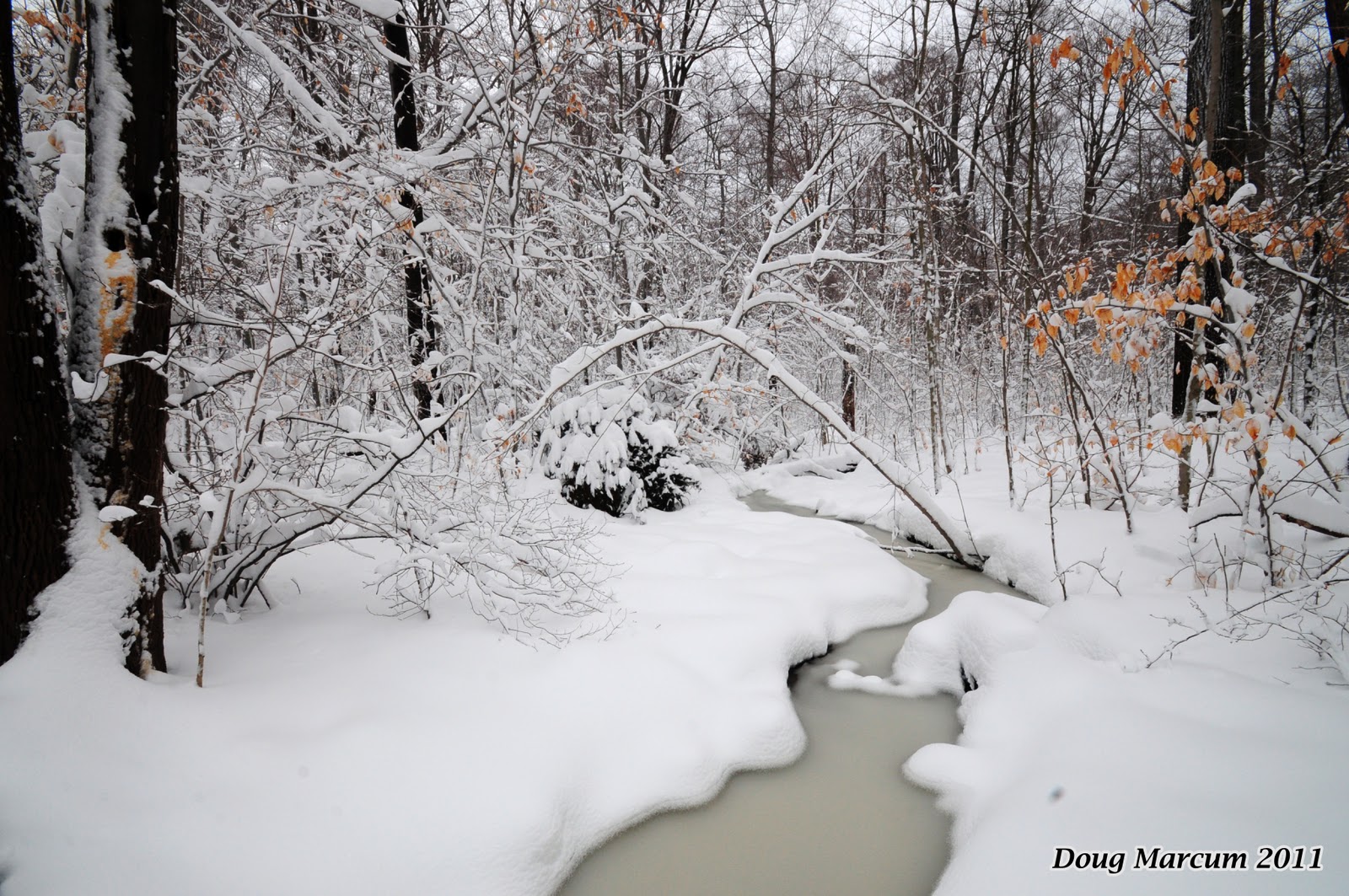
I have a story to tell about today, but first, I had a great weekend. A brief summary; Friday, Brad and I went for a Winter wonderland hike at North Chagrin Reservation. I can't believe that we got all this snow in one night!!!


I mean, I guess this LAST (please!!) covering of the cold white stuff was very pretty, but I'm ready to move on to other pretty things that SPRING has to offer : )  So to get a sneak peak, Chia and I headed down to the Southern half of the state, and left all of the snow and ice behind! Saturday was ridiculously warm! By the time we met my buddy South of the Columbus area, I was in short-sleeves and rolled up jeans. We went out to explore some vernal pools. Without boots, I got into the pools barefoot - yeah, I know, I've been called a hobbit before, it's ok.

sitting amongst calling wood frogs : )

Listening to a chorus of Spring Peepers and Wood Frogs never gets old. Especially after a long Winter. I haven't heard any in my neck of the woods yet, but like I said, I wanted to get a jump start on things further South. We had much luck that day, finding many Spotted Salamanders, as well as some Jefferson, Small-mouthed, and Redbacks. There were plenty of egg masses in the pool as well. Great spot. Here are some photos:

Jefferson Salamander (male)

Jefferson Salamander eggs

I love salamanders, but I love frogs even more. I used to have treefrogs as pets growing up. Raising tadpoles is always a great learning experience too (as a kid or anytime!) Anyway, I went on the challenging task to spot some of the hundred Spring Peepers that I was hearing. I got lucky. Once I located a male by his expanded throat pouch, I sat and watched, and I noticed more and more peepers around! They were everywhere! I must have spotted 10 or more within a 4-foot radius of where I was standing! This beautiful rusty colored male gave me a show:


Another highlight of the trip down South was my first snake(s) of 2011!  Chia spotted them. Two garters right near the den. One slipped back into the den but I was able to photograph the other. He (or she) was a feisty fella who took a snap at me! He had some battle scars and was missing one eye, good luck to him this year!! I took a couple quick shots then we left him alone to enjoy the brief March sun.


Oh, and I guess since I went into a bit more than a "brief summary", I might as well finish by giving a quick list of the waterfowl species that we observed Sunday morning while heading back North through Columbus. We stopped at one of the Metroparks, Pickerington Ponds.  This place had some nice wetlands along with great viewing areas and blind to observe!!!  Species we tallied; Ring-necked Duck, Lesser Scaup, American Wigeon, Ruddy Duck, Green-winged Teal (my first!!), American Coot, Horned Grebes (molting and ugly for the moment), Gadwall, American Black Duck, Redhead, and of course, Mallards and Canada Geese. I don't think I forgot any...oh and we did hear and see an Eastern Meadowlark singing : )


Tuesday, March 8, 2011

Ahhh, What a Wonderful Day...

D
Chagrin Tributary, originally uploaded by DMarcumPhotography.
I decided to get up early this morning so that I would have time to go explore and photograph hopefully the last of the snow for this season. The snow that came down Saturday night was just so beautiful on all of the trees and everywhere, I kicked myself for not getting any photos. I was busy working my horrible job at the Mentor Marsh Nature Center : P

It was a fun day at work, I am working on an informative bird display that will emphasize bird behavior in Spring. Wow, I actually get paid to do this??? Hahaha, living the dream. We also went on a nice walk to look for and interpret tracks in the fresh snow. We had 8 people total on the hike and it seems like everyone enjoyed it. We saw a Cooper's and a Red-tailed Hawk fly by, as well as a group of 5 Tundra or Trumpeter Swans..too hard to ID from the fly-over.

Anyway, my hike this morning was beautiful. One of my secret spots...some of you may recognize it, but I'm not telling hahaha (sorry). I promise I only have like 3 secret spots. 2 of which are within the Grand River and her tributaries, the other within Chagrin's. The sun came out and told Winter that it was time to start melting away. I heard the Song Sparrows singing about it. As I walked along the creek, I continuously stared in awe at the beauty of this sunny morning. The snow was doing that special glistening of every color again.


Hemlock gorges are automatically my favorite habitat type, and if I lived in the wild, that is where I'd live. Everytime there is a creek around, I inevitabley end up in it. Speaking of living in the wild, I have found recently that foxes and I think alike when it comes to choice of path through the woods. We both love walking along ridges of valleys, and I frequently find myself following fox tracks without meaning to. As was the case this morning.


Other than some tracks and some typical birds singing, I don't have much to report as far as wildlife and ecology goes. I took this hike this morning just to get out an enjoy the beautiful landscapes of Winter coming to an end, so I spent more time composing photos than anything else.


After leaving my secret location, I had to head back to Kent for class, which I unfortunately ended up missing (so sad). Since I now had extra time, I stopped by Crystal Lake which is a small preserve owned by The Nature Concervancy. I am the preserve moniter! Yippee! I took a short hike around to scope the place, and discovered 3 hawk nests. None of them appeared to be occupied though : ( I will continue to check for activity...

On the way to my house from Crystal Lake (which is only a few miles down the road) I scanned one of the reservoirs on the side of the road and spotted 6 Hooded Mergansers. 5 males, 1 female. Poor girl. Males were getting rowdy too. I am ready for the ice on all of the reservoirs to melt away so I can go looking for more waterfowl!

I finally got back to "reality" and went to my other to classes for the day. Great day overall, I even had time to ride my bike over to the wetland on KSU property (the one I always mention) and I watched a possum (Virginia Opposum technically) eating a big dead catfish on the side of the pond. I saw at least 5 of these fish dead in the area, they must have froze : ( At least the possum gets to eat! (As well as other scavengers including a Bald Eagle).


 Lastly, I got to see my Mockingbird for the second time in a week on the property, I don't see Mockingbirds too often for some reason, so I always enjoy watching them. Seems he is fond of eating fruits. Ok well I must finish this up and get to sleep I have to wake up at 6:30AM to go out and do some bird-watching in the morning : )

Monday, March 7, 2011

Salamander Hunting : )

I believe that their is fun to be had all year long...and in nature, there is always something new to see in every season. I mean, Winter was cool and all, but I think I can speak for 99% of Ohions and say that it's time for Spring!!! What I'm getting at is that in a way, this weekend kicked of the beginning of a chain-reaction of events that occur in the natural world here in Ohio, and I know REALLY have things to look forward to on a daily basis!

It warmed up into the 50's yesterday with a little rain, so Chia and I decided that it was time to go out salamandering!!! Our buddy Matt met up with us at the Mentor Lagoons...a spot that I frequent year round. There are some nice vernal pools here, and the woods are gorgeous as well. I'm sorry that I didn't take my camera out with me yesterday, but lugging around that bag of bricks on my back EVERYWHERE I GO gets old sometimes. I feel so free when I'm exploring the woods carrying nothing. Plus I can act more like a wild animal : )  Jump higher, climb trees easier, and just manuever quicker in general. If I wasn't a human, I would be a gibbon monkey ; )

Anyway...for a while we didn't have much luck with the salamanders. We had found one egg mass (later to be determined as Small-mouthed Salamander) and plenty of spermatophores stuck to leaves and twigs in the pools. A brief lesson on mole salamander breeding: Mole salamanders spend most of the year underground and under logs...they only come out when it is time to breed (for most species this occurs in early Spring after/during warmer rains). The males will usually get to the pools first and deposit the spermatophores. Females show up later and fertilize themselves with the spermatophores, then lay their eggs. The eggs are stuck together in a gelatinous mass, and the typical number of eggs in a mass varies by species. The babies will be born a few weeks afterwards...I will have a follow up blog on that once it is occuring and I will hopefully accompany my text with some wonderful pictures...I finally ordered my macro lens that I promised myself I'd have by Spring this year : D

No salamanders til this point, but then we had some luck. I was drawn to this huge beautifully twisted and gnarly Silver Maple on a mound of soil in the middle of a flooded pool. After taking my time admiring the structure of this old hollowed out tree (that was still very alive), I looked down and saw beautiful bright yellow spots! A Spotted Salamander was just sitting on the base of the tree not moving at all. Matt and Chia rushed over to get a look at our first salamander of the year. What an exciting moment : ) From here on out, there will be many "firsts" of the year and I am so ready!! Chia got some nice photos of the mac (Ambystoma maculatum) so maybe I can get him to send me a few photos from the day to accompany my blog. Here's one of me in the tree...


Rewinding, before the Spotted, I watched a male Wood Duck leaving from a Maple tree with a nice cavity (I didn't actually see him in the cavity) so I am hoping that he will get a mate and they will nest in it. The spot is jotted down in my mental notebook, so I will keep tabs on it! Other bird sightings included A Cooper's Hawk, a Red-shouldered Hawk fly-over, and some of the usual suspects (Titmice, Chickadees, Cardinals, etc.)

Oooh! I almost forgot! While flipping logs searching for salamanders I found a Hairy-tailed Mole! It was a first for me, I got to watch him run around in and out of a few tunnels for a minute before he disappeared. When I saw it I instantly noticed the odd-looking tail, and as soon as I got to a field guide to identify it, I figured it out. Seeing a new species for the first time is always a memorable and exciting experience  : )  I tried to get Chia over to get some footage of it, but he didn't make it in time.

Matt ended up going home, and Chia and I moved to another section of woods to continue our salamander search. I had my eyes trained down all day, and when I looked up after hearing a cracking noise in front of me, I was surprised to see a male Pileated Woodpecker just chipping away at a tree no more than 20 feet away!!! It was so awesome, you usually don't get that close to them! Once again, no camera...sorry! It is crazy how much of a "photographer" I've become, I never figured that it would be this way but I am always thinking of my next photos or how I wish I had my camera in the rare occurance that I didn't bring it. I try to tell myself just relax and take in the moment, but it doesn't always work that way...anyway...it was still wonderful to watch him so close : )

Speaking of cracking, we heard and saw a pretty large Beech tree fall while we were in the woods! That makes two trees that I watched fall. It's pretty cool. This one was probably about 30" diameter.

Finally at our last pool, Chia's hard work of sweeping his net for hours paid off. He came up with two Small-mouthed Salamanders (Ambystoma texanum). This was the missing puzzle piece because we had found the eggs and spermatophores prior. We wanted to go back out tonight, but the snow pretty much cancelled that for us, so I will be back into the pools as soon as we get more rain : )


Chia and I headed out of the woods just in time for Chris to meet me in the parking lot. Chris and I then headed over to the Zimmerman trail...I just can't be outside enough : )  Since it was almost 5pm, I figured we could go peek around by the Beaver lodge that is over there and see if we could see any action. There are also a pair of Great-horned Owls (possibly nesting) in the area so we figured we might see or hear them too. No such luck though with either. We had a nice little hike, and heard and saw mixed flocks of Grackles and Red-winged Blackbirds, and the best prize for that hike was the resident pair of Bald Eagles perched in one of their favorite areas along the Northwest edge line of the woods along the marsh. They seemed pretty tolerant of us and we watched them for a moment and basically left them alone. It's nice when wildlife cooperates, especially when you don't have your camera. Getting a chance to watch actual behavior instead of behavior in the presence of predators (us).

I think I'm about done writing about my wet day in the marsh, but much more to come on amphibians in the next few weeks!! The way I see it is salamanders, frogs, waterfowl, wildflowers, birds and so on!! From here on out Spring has begun in my book and the fun begins : )  Hopefully you can get out and witness the beauty and nature's seasonal specialties for yourself!

Friday, March 4, 2011

Flooding!


Wet Woods, originally uploaded by DMarcumPhotography.
I haven't posted in a while...I guess I have had a few things to write about since my last post, but no photos to show so I couldn't do it. Anyway, we have definitely had some great advances towards Spring in the last couple weeks!! Hmm let's see, catching up - Turkey Vultures have been back around for a couple weeks now. Red-winged Blackbirds have been coming in since early last week. I have been hearing Song Sparrows on the regular since last week, and other birds like Cardinals, Titmice, and Chickadees have been singing much more than previously too! This is all wonderful : )

After the awesome thunderstorm that we had on Sunday night, we had some serious flooding! Even now, the watersheds are still way high. I went out on Wednesday to check out a heron rookery that is in Kent. Because of the high water in and around Breakneck Creek, I couldn't get very close to the nests at all (it is better not to disturb them much anyway) I wanted to scan the area to get a head count on the herons, and also check to see if any Great-horned Owls hapened to be occupying a nest. They are known to be found using heron nests (among many other nests). The area around the rookery is beatiful, and there were a bunch of woodpeckers around making a racket the whole time I was there. Mallards were also feeding in the flooded woods. I saw plenty of beaver evidence, then the beaver himself decided to let me know that he didn't want me around and slapped his tail on the water at me a couple times! I love beavers : )

 I thought that I wasn't going to be able to see the herons, but for some reason they all flew off the nests at the same time and I was able to get a rough count of about 25 birds (that were flying at least). There are way more than 25 nests. I'm going to go back soon when it isn't so flooded and see if I can get a bit of a closer look. Nesting activity is on the way!

Apparently it is supposed to rain more this weekend, so I hope that it helps thaw out the ground and melt the snow! I'm ready to start looking for amphibians : )